Introduction:
Brinjal or eggplant (Solanum melongena L.) is one of the most widely cultivated vegetable crops in India and plays an important role in household nutrition, local vegetable markets, and farmers’ livelihoods. In many parts of India, brinjal cultivation supports small and marginal farmers through year–round production and steady market demand. Yet, one important factor often overlooked in brinjal cultivation is pollination. While fertilisers, irrigation, and pest management receive majority of the attention, pollinators quietly contribute to fruit development and crop productivity
A recent study conducted on farmers’ fields highlighted how managed pollination can significantly improve the yield and fruit quality of brinjal crop. The study compared the effect of Indian honey bee Apis cerana indica and Stingless bee (Tetragonula sp.), and pollinator exclusion control conditions on the fruit set and crop performance under field conditions.
Pollination is a natural biological process that directly influences fruit formation and crop productivity. Insect pollinators transfer pollen from the male parts of a flower to the female reproductive structures, thereby improving fertilisation efficiency and fruit development. Although brinjal flowers possess the ability for self-pollination, insect visitation significantly enhances pollen movement, fruit set, and seed development, thereby improving yield stability and marketable produce in many horticultural crops (Klein et al., 2007; Free, 1993).
In recent decades, pollinator populations have declined globally because of habitat destruction, excessive pesticide use, agricultural intensification, and climate-related disturbances (Potts et al., 2010). This decline has raised concerns about food security and agricultural sustainability. As a result, researchers and farmers are increasingly exploring managed pollination systems involving honey bees and stingless bees to improve crop productivity while supporting biodiversity conservation. A study conducted at a farmer’s field evaluated the influence of managed pollination on brinjal yield and fruit quality. The findings demonstrated that managed pollinators, particularly stingless bees, can substantially improve fruit set and crop performance in brinjal cultivation.
Importance of Pollinators in Brinjal Cultivation:
Brinjal flowers are structurally adapted to benefit from insect visitation. The anther tube in the brinjal flower is compact, and pollen is released more effectively through vibrations produced by visiting bees, and pollen is efficiently dislodged during bee visitation and buzzing behaviour. When bees visit flowers in search of nectar or pollen, they facilitate pollen transfer between flowers, thereby improving fertilisation efficiency. Better pollination generally leads to increased fruit set, reduced flower bloom abortion, improved fruit size and weight, enhanced seed formation, better fruit shape and quality. Previous studies have shown that bee pollination significantly improves reproductive success in vegetable crops, especially in tropical agroecosystems where pollinator diversity is relatively high (Garibaldi et al., 2013).
Despite their ecological importance, pollinators are often negatively affected by intensive farming practices. Broad-spectrum insecticides, removal of flowering vegetation, and habitat fragmentation reduce nesting and foraging opportunities for bees. Sustainable agricultural systems, therefore, require farming practices that conserve and support pollinator populations.
Experimental Design:
The investigation was conducted on the fields of three farmers. Irrigated field locations represent typical vegetable-growing regions characterised by tropical semi-arid climatic conditions, moderate rainfall, and mixed farming systems.
Three pollination treatments were evaluated: treatments involving Apis cerana indica, Stingless bees’ pollination, and a control treatment (Pollinators exclusion). Flowers under each treatment were tagged, and precautions taken to prevent any further interaction of pollinators. Flowers assigned to the control treatment were covered using pollination exclusion cages to prevent insect visitation. Flowers blooming on the same day were selected and tagged. Managed bee colonies were placed near experimental plots to encourage active pollination. Observations included fruit set percentage, tagged fruit/flower abortion, fruit length, fruit girth, fruit weight, pest infestation, fruit abnormalities.
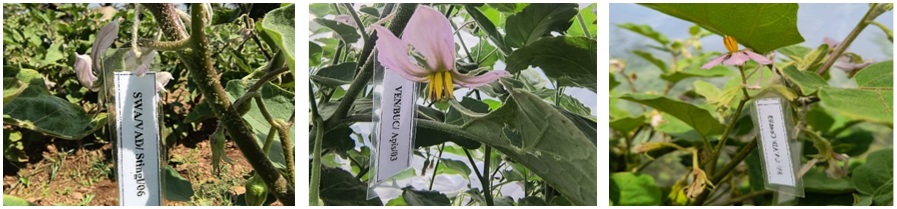
Figure 1. Experimental brinjal field showing tagged flowers under different managed pollination treatments.
Results
The study revealed that stingless bee pollination produced superior yield and quality parameter results compared to Apis cerana indica pollination and pollinator-excluded control treatments.
Table1. Effect of different pollination treatments involving Apis cerana indica, stingless bees, and pollinator-exclusion control on fruit set, fruit abortion, and average fruit weight of brinjal (Solanum melongena L.)
|
Parameters |
Apis cerana indica | Stingless bee | Control (pollinators- exclusion) |
| Fruit set (%) | 60.0 | 75.0 | 40.0 |
| Fruit abortion (%) | 33.3 | 25.0 | 41.7 |
| Average fruit weight (g) | 61.09 | 74.63 | 53.80 |
Percentage increase compared with control:
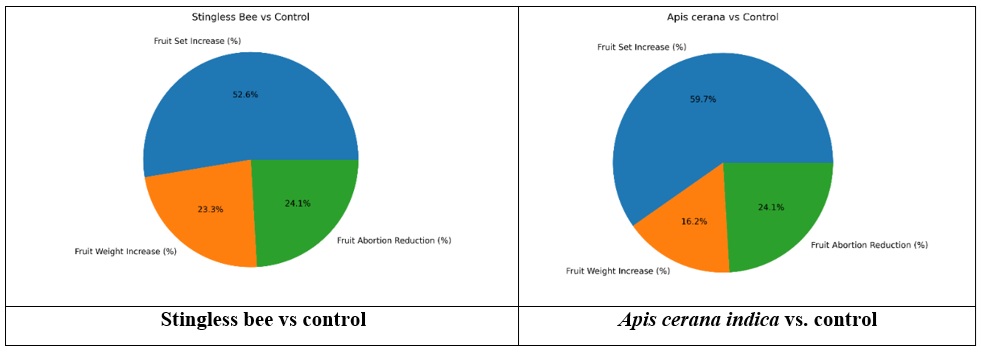
Figure 2. Percentage increase in fruit set, fruit weight, and reduction in flower/fruit bloom abortion under stingless bee and Apis cerana indica pollination treatments, compared with pollinator-exclusion control in brinjal (Solanum melongena L).
Major Observations:
A total of 108 flowers were tagged, of which 73 successfully developed into fruits. Higher fruit set was recorded under stingless bee pollination treatments, total flowers tagged, and fruit set. Fruit abortion was lowest in both bee-pollinated flowers. Apis cerana indica also improved fruit set, compared to control treatments. Pollinated plants produced larger and heavier fruits. Control treatments showed comparatively poor fruit development.
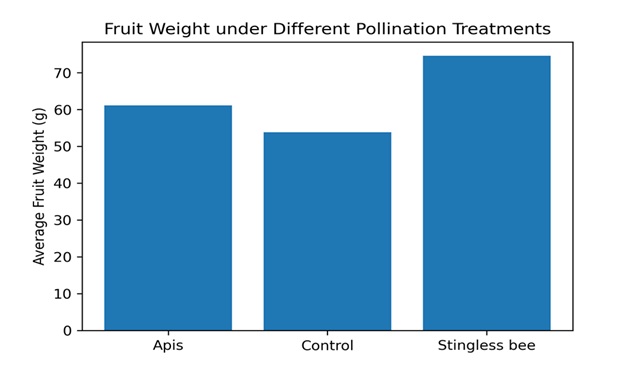
Figure 3. Average fruit weight of brinjal under different pollination treatments.
Why stingless bees are emerging as important pollinators?
Stingless bees are increasingly recognised as efficient pollinators in tropical agriculture. Unlike larger honey bees, stingless bees are well adapted to warm and humid climatic conditions and can forage continuously throughout the day. Several characteristics make them suitable for vegetable pollination such as non-aggressive behaviour, continuous flower visitation, and longer interaction with flowers, and adaptability to tropical agroecosystems. Their role is particularly valuable in smallholder farming systems where maintaining ecological balance is essential for sustainable crop production. Studies conducted in tropical regions have also reported improved fruit development under stingless bee pollination (Abrol, 2012).

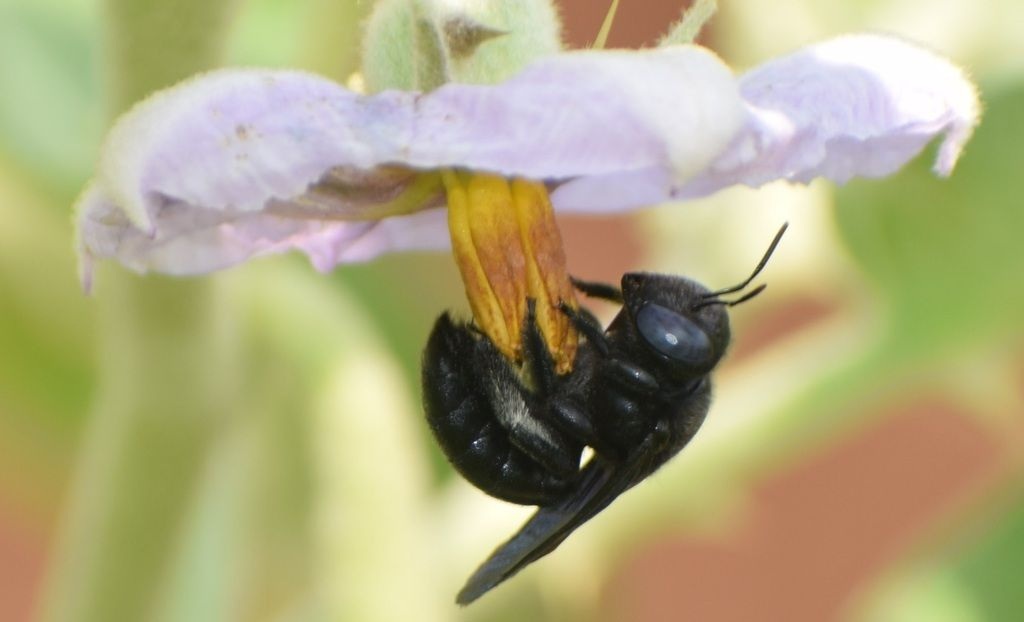
Figure 4. A stingless bee visiting a brinjal flower during active pollen collection.
Pollinator-Friendly farming and Sustainable Agriculture:
The findings of this study demonstrate that pollinator conservation is not merely an environmental concern but also an economically beneficial farming strategy. Pollinator-friendly farming can improve crop productivity, fruit quality, farm income, biodiversity conservation, and ecosystem stability. Farmers can encourage pollinator populations by adopting simple ecological practices such as reducing unnecessary pesticide application during flowering period, conserving flowering plants around farms, maintaining natural nesting habitats and integrating managed bee colonies into cropping systems. Such approaches contribute to ecological intensification, where natural ecosystem services improve agricultural productivity sustainably.
The field study demonstrated the significant role of managed pollinators in improving brinjal yield and fruit quality under real farming conditions. Among the treatments evaluated, stingless bee pollination produced the highest fruit set, lowest abortion percentage, and maximum fruit weight. The findings highlight the growing importance of integrating pollinator management into vegetable farming systems. As agricultural sustainability becomes increasingly important, managed pollination offers a practical and eco-friendly approach for enhancing crop productivity while conserving biodiversity.
Supporting pollinators ultimately benefit ecosystem as well as farmers. By protecting and promoting pollinator diversity, farming communities can achieve better yields, improved fruit quality, and more resilient agricultural systems.
References:
- Abrol, D.P. Pollination Biology. Springer.
- Free, J.B. Insect Pollination of Crops. Academic Press.
- Garibaldi, L.A. et al. Wild pollinators enhance fruit set regardless of honey bee abundance. Science, 339, 1608-1611.
- Klein et al. Importance of pollinators in changing landscapes for world crops. Proceedings of the Royal Society B, 274,303-313.
- Potts, S.G. et al. Global Pollinator Declines: trends, impacts and drivers. Trends in Ecology & Evolution, 25, 345-353.
Co-authors: Arun Shankar, Sadashiv Nimbalkar

Vinod Borse
Associate Thematic Programme Executive (Agroecology)
BAIF Central Research Station, Uruli Kanchan, Pune
0 Comments