Crop cultivation
Crop cultivation through climate change initiatives

Crop cultivation through climate change initiatives

Food security from successful wadi cultivation
Prosperity from tree-based farming on drylands

Improved productivity with soil and water conservation

Successful nursery management of mango grafts

August 15, 2021: On the occasion of the 75th Independence Day of the country, BAIF organized a plantation programme at Ahari Tola School of VP Bathiya village in Satna district of Madhya Pradesh under the Integrated Sustainable Livelihood Project supported by Birla Corporation Ltd. The programme was attended by the General Manager of Birla Corporation.

Aug 12, 2021: Youth are an important plank of BAIF’s integrated development programme. The local youth have played a significant role in community development through their active participation in various development programmes launched by BAIF in remote villages across the country. These barefoot technicians have encouraged the community to adopt appropriate technologies for rural prosperity. Over the last one decade, realizing the role of urban youth too in the process of development, BAIF has launched various Fellowship programmes.
Under the SBI Youth For India Fellowship Programme, 9 youth and 5 youth under the SPARK-Janarth Fellowship Programme placed in various locations of BAIF, are involved in community mobilisation and application of appropriate science and technology in rural development. Some of these enterprising youth are also engaged in pilot production of pen stands, earthern lamps making use of cow dung; pine needle for making various handicrafts; digital promotion of BAIF’s tribal initiative Nahari; graphical and interactive manuals and identifying scalable interventions in value chains for locally abundant produce like Amchur (mango powder) and Mahua flowers and seeds. These youth are truly bridging the gap between rural and urban India.
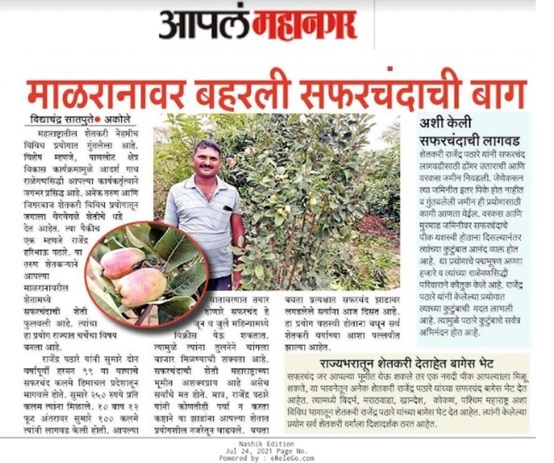
July 24, 2021: Rajendra Pathare, a young farmer from Ralegansiddhi village, has successfully cultivated apples on a barren piece of land thereby squashing preconceived notions of apple being suitable only for regions with cold climate. His successful experiment with an apple variety has shown the path to other farmers who out of curiosity and eagerness to also adopt the cultivation of this fruit in an otherwise unsuitable terrain, are visiting his farm on a regular basis. They will definitely benefit with the availability of another fruit crop which is popular among consumers.

On July 18, 1973, the Foundation Stone of BAIF Central Research Station was laid at Urulikanchan near Pune by Hon’ble Shri. Y.B. Chavan, the-then Union Finance Minister and Chairman of BAIF. In 1971, BAIF had received 200 heifers of Holstein Friesian and Jersey breeds from Denmark which had been housed at this campus. In the absence of adequate finance, the construction of the laboratories was delayed. Manibhaiji explained the noble cause for which the facility was needed, to Shri. B.G. Shirke, a local entrepreneur, who agreed to support and brought down the cost of construction to 30% of the market rate. The building was completed in record time. The laboratories became functional from January 1974.
Today, the Research Centre, spread over 227 ha, with world-class laboratories, exotic bull mother farm and bull station, is engaged in state-of-the-art applied research, demonstration and extension of latest technologies in agro-based livelihood activities and is one of the Centres of Excellence in Animal husbandry and allied activities in India.

A MoU was signed between Maharana Pratap University of Agriculture and Technology (MPUAT), Hindustan Zinc Limited (HZL) and BAIF on 16th July, 2021 in the presence of Dr. Narendra Singh Rathore, Vice Chancellor, MPUAT, Mr. Bharat Kakade, President, BAIF, Ms. Anupam Nidhi, Head – CSR, HZL, Deans, MPUAT Colleges and HZL and BAIF Project teams.
The tripartite agreement aims at benefitting more than 30,000 farming families through various agricultural and livestock innovations under the SAMADHAN Project which is currently being implemented with the support of HZL.
Ms. Anupam Nidhi, emphasised on the need to encompass climate smart agriculture and carbon neutral initiatives apart from improved agricultural practices, ensure better remuneration to the farming community through community-based organizations with focus on post harvesting technologies and processing units and recognize the critical role and contribution of women farmers to the agriculture sector.
Dr. Narendra Singh Rathore highlighted the need to empower farming communities through large-scale integrated farming system and ensure food security. With the transformations in agricultural practices, emphasis on plant health was necessary to ensure ecological balance as well as food safety, he added. In the long run, natural farming would provide more benefit to the farming communities, he further added.
Mr. Bharat Kakade expressed his appreciation of the scope of the partnership in creating space for ushering in synergy which in turn can lead to impactful transformation. He also stated that considering the present challenges posed by climate change, such collaborations can provide further opportunities for developing and implementing programmes for the benefit of the rural communities.
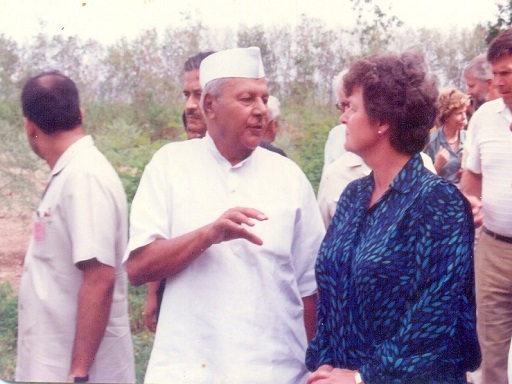
On July 7, 1987, Mrs. Gro Harlem Brundtland, Prime Minister of Norway and Chairperson of the Brundtland Commission, who had come to New Delhi to launch the Report of the Brundtland Commission – “Our Common Future”, took a special flight to Urulikanchan near Pune, to view BAIF’s afforestation programme which was very popular in the country. She was very impressed with the Subabul plantation.
In 1976, “Hawaiian Giant” type of Leucaena had transformed most of the barren lands of BAIF into Leucaena seed farms while leading wood-based industries, procured Leucaena wood from BAIF for production of paper and newsprint. Considering its utility and benefits, in 1981, Prime Minister of India, Mrs. Indira Gandhi, renamed the “Kubabul” plant as “Subabul”. BAIF launched several Agroforestry, Wastelands Development and Industrial Greenbelt Development Projects in collaboration with leading Industries and Forest Department across the country.
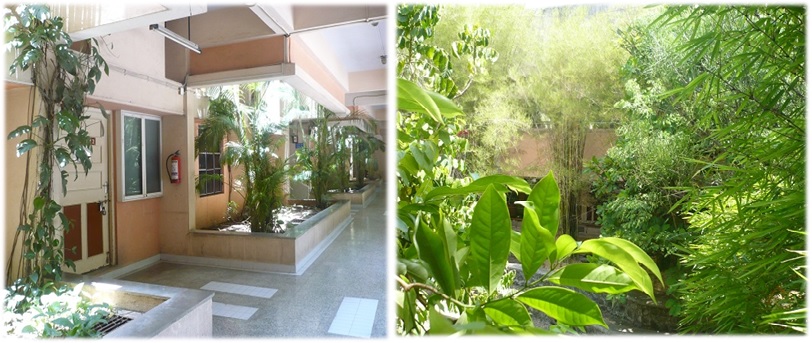
June 19, 1996 – The dream of the Founder of BAIF, Dr. Manibhai Desai, to establish a unique training centre in Pune to impart management skills to professionals and field functionaries engaged in rural development, was fulfilled when Mr. Stanley Gooch, High Commissioner of Canada in India, inaugurated the “BAIF Bhavan” and “Dr. Manibhai Desai Management Training Centre” at Warje in Pune. The Training Centre with its spacious Classrooms, Conference hall, Board Room, IT Hub, Dining hall and Guest House, is spread over 8 acres. Trainings are imparted on Rural Livelihoods, Watershed Management, Climate Change Adaptation and Mitigation, Project Management, People’s Organisations and Soft Skills.
June 19, 2021 – This year marks the 25th year of the inauguration of BAIF Bhavan and Dr. Manibhai Desai Management Training Centre. The green cover amidst fast-paced urban development and serene surroundings, have developed a harmonious relationship among BAIF professionals in the premises and a close bond with the organisation. The model Training Centre, is one of its kinds in the country. For the BAIF family, BAIF Bhavan is much more than a structure. It is a part of their lives.