New Programme Launch by BAIF

New Programme Launch by BAIF

“Mantra (ways, means and solutions), Tantra (technology), Disha (direction) and Gati (speed) are the wheels of planned development apart from participatory and community-led planning and implementation”, stated Mr. Girish G. Sohani, President and Managing Trustee, BAIF Development Research Foundation. “Adoption of these elements for ecosystem and economic well-being, thrust on decentralised employment and enterprise development and considering the village as the unit of development, can further strengthen the rural economy”, Mr. Sohani added.

Mr. Sohani was speaking at the virtual forum of the 2nd Rashtriya Sarpanch Sansad (National Village Heads’ Parliament) organised by the MIT Institute of Governance, Pune, on December 2, 2020. He further emphasised the role of every Sarpanch in consolidating the Seven Pillars of Development namely, Youth Power, Resilience, Sustainability, Green Economy, Enterprise Promotion along with Goal setting and clearly defined Milestones. There is a need to catalyse the process of development, so as to tackle climate change effects, ensure optimum use of renewable resources and promotion of new age enterprises based on renewable energy, ICT, and appropriate technologies such as polyhouses and small holder farm mechanisation. “Development should focus on new age ‘green enterprises’ in rural areas and creation of jobs around such enterprises for rural youth who may be reluctant to engage only in farming”, he further added.

He also highlighted the important role of Sarpanch/Village Heads during these challenging times of COVID and Climate Change-related disruptions and shared the Best Practices demonstrated by BAIF in the form of a cadre of over 5000 self-employed youth and community functionaries such as e-Dosts, rural technicians and service providers. He also assured handholding support from BAIF while planning for village development.

He announced the launch of Samruddha Gram Abhiyan, an ambitious participatory programme with the active involvement of local youth as the vehicle for grassroots development and invited the Sarpanch and Village level catalysts from various villages across the country, to register for this novel programme at https://manibhaiunnatgram.baif.org.in/ “This programme will be based on the learnings of BAIF’s rural livelihood programme and various successful development projects implemented by BAIF and will be implemented through Gram Panchayats, Farmer Producer Organisations and Watershed Development Committees to showcase various interventions which can be introduced with BAIF support at the village level”, he concluded.

New Programme Launch by BAIF

Webinar on Ethno Veterinary Practices for treatment of Mastitis in milking cows

BAIF and Sakal Media Group jointly organized an online training programme on “Ethno Veterinary Practices for treatment of Mastitis in milking cows” on December 2, 2020. Dr. A.B. Pande, Group Vice President, Scientific Research and Livestock Development Programmes, highlighted the significance of Ethno Veterinary Medicine for improvement of milk quality while emphasising on the residue free milk – antibiotics and chemical residues. Mr. S.D. Nimbalkar, BAIF, delivered a talk on the use of Ethno Veterinary Practice as an alternate system of medicine for control of Mastitis and shared the BAIF experience in Karnataka, Maharashtra and Gujarat. Dr. Amul Wagh, BAIF Institute for Sustainable Development, Gujarat, briefed about the symptoms, cause and precautions for control of mastitis in cows and the encouraging mastitis cure by use of Ethno Veterinary Medicine at farmers level in Gujarat. 28 participants comprising of veterinarians, youth and farmers attended this programme.

New Programme Launch by BAIF

National Webinar on Ethno Veterinary Practices

BAIF in partnership with the Rashtriya Kamdhenu Aayog, Government of India, organized an online webinar on “Ethno Veterinary Practices” on October 28, 2020 which was chaired by Dr. Vallabhbhai Kathiria, Chairman, Rashtriya Kamdheny Aayog. The webinar focused on importance of Ethno Veterinary Medicine in Goshala and among livestock keepers in rural India. A talk on “Use of Ethno Veterinary Practice for Mastitis in cows – BAIF experience” was delivered by Mr. Sadashiv D Nimbalkar, BAIF. The other speakers included Prof. Punnaimurthi, TANUVAS, Tamil Nadu, Dr. Balaram Sahu, Odisha and Dr. Bankim Patel, MD. Homoeopath, Bubaneshwar More than 250 participants comprising of Government Officials from Veterinary Department, Veterinary Collages, NGOs and farmers attended the online meeting.

BAIF Foundation Day Celebrated Virtually

BAIF Foundation Day Celebrated Virtually

The BAIF family celebrated their 53rd Foundation Day on August 24, 2020 virtually. In a way, the virtual celebration was very memorable for over 200 BAIF field officers from 12 states who came together to make it a special celebration.

“With women having taken the drivers’ seat, the field programmes are in an expansion mode’ stated Mr. Bharat Kakade, Executive Vice President of BAIF in his opening remarks. The programmes are now benefitting more than 50 lakh families in 12 states. Livestock development programme, the flagship programme of BAIF, has reached out to 44 lakh families, through 4700 AI technicians operating through their cattle development centres across the country and enabling our farmers, mostly marginal and small holders to produce milk worth Rs. 15000 crores. Every year about 10 lakh new progeny of high genetic merit are born at the doorsteps of small farmers. The Central Research Station at Urulikanchan has been producing embryos from its state-of-the-art OPU and IBF laboratory and for the first-time streamlining genome sequencing. Construction of climate smart bridges have been the outcome of the climate change adaptation and mitigation programme,’ Mr. Kakade further added.

Mr. Girish Sohani, President, BAIF, dwelled on the survival mechanisms adopted by BAIF to support farmers and to continue their farming activity and revival of the rural economy against the COVID 19 challenge.

Shri. Hrishikesh Mafatlal, Chairman, BAIF, listed the challenges ahead of BAIF to meet the knowledge, skills and values and to help others in society. He also emphasised on the strong value system of the organisation and its unique technologies, which are helpful to encash new opportunities and to minimise the difficulties. Shri. Kishor Chaukar, Trustee, BAI F, spoke about the need for phenomenal changes in the mind set at BAIF as well as in the society. Technology will be the strong pillar for upliftment of the poor. Shri. Sunil Lalbhai. Trustee, BAIF, highligted the need to be self-reliant and develop insights into the emerging needs of the people at the bottom of the pyramid in the birth centenary of the Founder of BAIF. He defined the five learnings for growth of the organisation which will lead to a continuous learning organisation.

Dr. Ashok Pande, Group Vice President, Scientific Research and Livestock Development, appreciated the role of the field team in strengthening the livestock development programme of BAIF through applied research, input production, genomics, animal nutrition and field research for the benefit of the farmers. Viewers were taken to the world of conventional semen laboratory established in 1975 followed by the world of a sophisticated sorted semen laboratory, and goat semen laboratory established in 2018 at Wagholi through screening of short duration videos as part of the virtual celebration.

Dr. Rajashree Joshi, Chief Thematic Programme Executive, BAIF Programmes, highlighted the feminisation of farming practices and the shift in the role of women who are now change makers and climate smart farmers. These were highlighted through short duration videos. Enterprise promotion through silage development at the farms itself, was highlighted by Mr. V.B. Dyasa, Regional Director, Western Region and Programme Director, BAIF. Digitalisation of programmes through epayment, elearning, mobile based telephony and edost was highlighted by Mr. Ramprasad while new programmes such as LMS and Cloud telephony services were presented by Dr. Alok Juneja with inputs from Ms. Nirali Shah and Ms. Pooja Majgankar with the focus being on replicability of digital initiatives. The Regional Directors of all the four Regions highlighted the growth of BAIF’s programmes in the midst of the pandemic, apart from record sale of 1.3 crore doses of conventional frozen semen, 1.5 lakh doses of sorted semen and 260 tons of mineral mixture. Mr. Shrinivas Kulkarni, Group Vice President, Finance, highlighted the social and financial capital aspects of BAIF with technology becoming central to BAIF’s horizon and the support from corporates becoming the trigger for strengthening rural India. Mr. Sujit Gijare, Group Vice President, Human Resources and Administration, emphasised on the human resource capital which ensured stability inspite of overnight sweeping changes brought about by the pandemic.

Special Lecture by Dr. Raj Paroda at BAIF, Pune

Special Lecture by Dr. Raj Paroda at BAIF, Pune

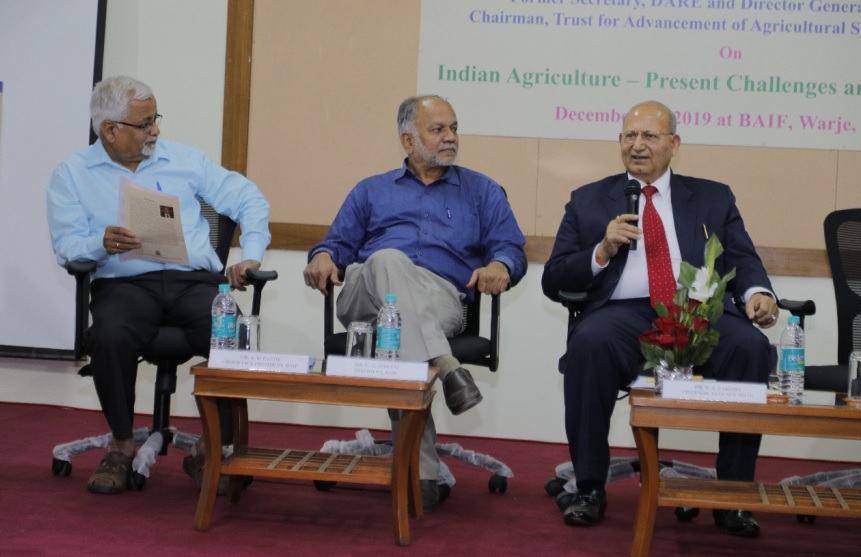
“Think globally but act locally” was the appeal made by Dr. Raj Paroda, eminent Agricultural Scientist of international repute and former Secretary, Department of Agricultural Research and Educat ion (DARE) and Director General, Indian Council of Agricultural Research (ICAR), New Delhi and presently, Chairman of the Trust for Advancement of Agricultural Sciences, New Delhi.
 
Dr. Paroda, a Padma Bhushan, FICCI and Norman Borlaug recipient, was delivering a Special Lecture on “Indian Agriculture – Present Challenges and Opportunities” at BAIF Development Research Foundation, Pune on Friday. “Genetically modified crops, precision farming using sub surface drip, technology capital and strengthening agri-marketing through reforms in APMC, ECA, Cooperative and FPC Acts and improving land management systems by revisiting land laws to check land fragmentation and encourage lease systems for collective/contract farming and promotion of bio fortified crops were some of the technologies identified by Dr. Paroda for achieving Sustainable Development Goals (SDGs)” apart from improvement in our Social Progress Index (SPI) and not just the GDP. He called for scaling up of hybrid technology especially of single cross maize hybrids which has shown fastest growth rate of 4 to 5% among cereals and urged the farming community to increase hybrid coverage (including QPM) from its current 60% to at least 90%. He also quoted the success story of BT cotton whose area of production has reached 11 to 12.0 mha, nearly 95% of the total area in the country, He also advocated the twin pillar strategy of genetic resource management along with natural resource management for sustainable intensification and quoted the Rice Wheat Consortium of National Agricultural Research System (NARS) – Consultative Group on International Agricultural Research (CGIAR) partnership programme to be the most successful eco-regional partnerships.
 
Conservation agriculture from the present 5.0 m ha to 10 m ha, biomass burning in India (40 mt of rice straw), managing crop residues through turbo happy seeder, on-farm water use efficiency and the paradigm shift in GM soyabean which is the leading oilseed crop now were also highlighted by him during his lecture. Inspite of achieving Green, White and Blue Revolutions, which changed the status of India from “begging bowl” to that of “self sufficiency”, the country still accounts for around 50% of the world’s malnourished children and has 22% of the people who live below the poverty line, Dr. Paroda lamented. The major challenges now, are household nutritional security, economic access to food, second generation problems of Green Revolution such as factor productivity decline, degradation of natural resources, especially land and water, increased incidence of pests and diseases and higher cost of inputs apart from the adverse effect of global climate change, he added. India, despite all its efforts to check its population (presently 1.3 billion), has added almost 15 million people (equivalent to one Australia) each year, thus nullifying the impact of agricultural advances. The SDGs are thus both an opportunity and a future vision for India, he stated.
 
Earlier, Dr. Paroda visited the BAIF Central Research Station at Urulikanchan and appreciated the adoption of cutting edge technologies such as livestock genomics, sexed-sorted semen technology, evaluation of jatropha genotypes, Adaptability Studies on Cactus / Mini-Apple and Aeroponics, Azolla, Aromatic Crops and Soil Health initiatives, apart from the involvement of women as change makers in agriculture. Shri. Uday D. Shirsalkar, Chief General Manager, NABARD, Maharashtra Regional Office, Pune, in his concluding remarks, highlighted land consolidation, capital formation, agricultural marketing and marketing reform and IOT in agriculture, value chain development and engagement of local youth who stay back in the villages and try farming, as some of the opp ortunities in Indian agriculture to overcome the challenges of fragmented land holding, shrinking of average land holding, lack of mechanization, higher consumption of pesticide in Maharashtra and inadequate storage facilities. Dr. Ashok B. Pande, Group Vice President, Livestock Development, BAIF, proposed the vote of thanks.
Providing Alternative Livelihood to Rural Families

Providing Alternative Livelihood to Rural Families

Nov 26, 2019:   www.maithiliprasang.com  In the HCIL sponsored Project – Providing Alternative Livelihood to Rural Families by Establishing Livestock Development Centre various initiatives have been taken by BAIF for improving livelihood of participants. This is one among such success stories.

Date: 26-11-2019
Location: Satna
Project: BISLD-HCIL, Dist. Damoh

BAIF Foundation Day Celebrated

BAIF Foundation Day Celebrated

The 52nd Foundation Day and Annual Award ceremony of BAIF was celebrated on August 24, 2019 at BAIF’s Central Research Station, Urulikanchan. “Neer, Nari and Nadi”, are the basic components of a balanced eco system. Only when science i s used with sense, will community wisdom be recognised”, stated Dr. Rajendra Singh, Chairman, Tarun Bharat Sangh, Alwar, Rajasthan. Solar energy needs to be used effectively for water conservation and Mother Earth nurtured through sustainable watershed management, climate change adaptation and mitigation methodologies and by guiding the community towards a river- based approach.

“Hydraulic drought, a serious effect of climate change, is changing the production pattern of food and fruit crops with apple orchards being the worst a f f e c t e d w i t h s e v e r e destruction of apple crops, while frequent droughts with atleast 2-3 in quick successions have direct impact on the lives of vulnerable families”, stated Mr. Bharat Kakade, Executive Vice President of BAIF. While BAIF has shifted to climate proofing measures such as desert development in Rajasthan and water conservation measures in drought prone Karnataka and Andhra Pradesh and climate resilient tree-based farming on dryland, it is necessary to assess which model is suitable for the community. Chemical- free farming has also been initiated on a pilot scale with the introduction of Integrated Renewable Energy and Sustainable Agriculture (IRESA) and Phosphate Rich Organic Manure.

Suman Self Help Group, a tribal group from Baretha village of Betul district, Madhya Pradesh, was awarded “Dr. Manibhai Desai Gaurav Puraskar 2019 and Smt. Vijayatai Deshmukh Gaurav Puraskar” for Best Self Help Group in BAIF Programme for its efforts to enhance village hygiene and sanitation through construction of 45 toilets under Water, Sanitation and Hygiene ( WA S H) Programme and Swachh Bharat Programme, use of waste water to establish kitchen gardens for intake of nutritious vegetables, p r a c t i c i n g o r g a n i c farming to reduce risk of chemical hazards and adoption of smokeless chulhas to reduce health and environmental hazards.

Bajrang Women’s Group from Dixal village, Kaprada, South Gujarat won the “Dr. Manibhai Desai Gaurav Puraskar 2019” for Second Best Self Help Group in BAIF Programme. The group launched a campaign for prohibition of alcohol in the village while establishing a grievance platform for marital disputes.

Sidheshwar Women’s Group from Shirapur village, Parner, Ahmednagar district of Maharashtra, was the recipient of “Dr. Manibhai Desai Gaurav Puraskar 2019” for Best Self Help Group in Maharashtra Programme. The group initiated Custom Hiring Centre through BAIF from 2017 and so far, they have earned more than Rs. 85,000 with 149 farmers from different villages availing hiring service of various farm implements. They have also p r o v i d e d a g r i c u l t u r a l i m p l e m e n t s t o n e e d y farmers free of charge.

Smt . Kempamani , Guddenahalli village , Holenarasipura, District Hassan, Karnataka was Best Dairy Farmer; Smt. Lalita Baraskar, Banspur village, Ghodadongri, District Betul, Madhya Pradesh was Best Agriculture Farmer; Smt. Nilu Devi, Sarobag, Dharhara, Munger, Bihar was the Best Farmer from Non-Potential Area; Shyam Sunder, Cattle Development Centre at Atai, Gautam Buddha Nagar, Uttar Pradesh, was the Best Cattle Development Centre In-charge; Manoj Wakode, Cattle Development Centre at Wari , Kopargaon , Ahmednagar, Maharashtra was Best AI Technician from Multi-Activity Centre; Anil Kumar Mishra, Cattle Deve lopment Centre at Chandanbhati, Bolangir district of Odisha for Best AI Technician from Non-Potential Area. Prizes were a l so g i ven to meritorious students and for the best scientific paper and case study. The BAIF Annual Report, Research Report and a book on Mahua Recipes were also released on this occasion.

The BAIF Shri. Uday Shirsalkar, C G M , NABARD, Maharashtra Regional Office, Pune, complimented the women fraternity who were felicitated for their work and for their confidence to share their experience. Ms. Ritu Nathani, Director, Cybage Software Pvt. Ltd. and Head – Cybage CSR, Pune, appreciated the women for establishing their identity through their empowerment. Others who spoke on the occasion were Dr. Anand Sardeshmukh, former Director General, MCCI and Shri. Sunil Lalbhai, Trustee, BAIF. Earlier, Dr. Ashok B. Pande, Group Vice President, BAIF, welcomed the women groups. Dr. Jayant R. Khadse, Research Director, BAIF, proposed the vote of thanks.

Great Expectations

Great Expectations

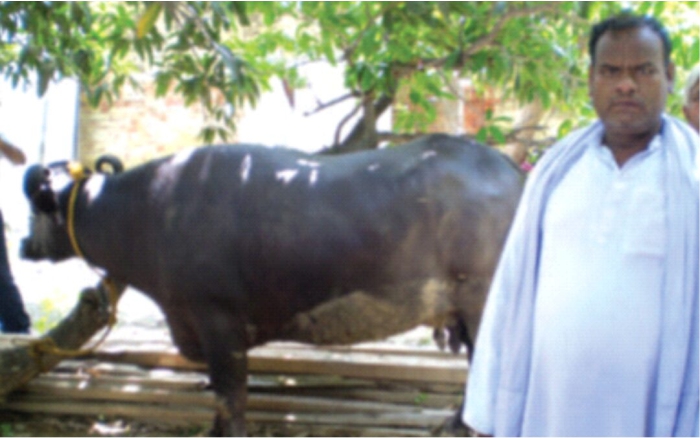
Subedar Yadav is a dairy farmer in Maudha village of Gazipur district of Uttar Pradesh, located on the border of Azamgarh district receiving cattle breeding services from BAIF’s Vizapur centre of Lalganj block in Azamgarh district. The livestock in this village is dominated by Murrah buffaloes as farmers have a good market for buffalo milk. Subedar was very fortunate to have a female buffalo calf born out of this programme which has now come into milk production and created a new record in the village by producing 18 litres milk per day in her peak. Recently, a buyer offered Rs. 72,000 for this priced buffalo but Subedar wanted Rs. 90,000 as he felt he could make more money by producing better quality heifers from this buffalo. Indeed! Even with one such buffalo, a farmer is able to attain prosperity.

From the Dark Shadows of Poverty

From the Dark Shadows of Poverty

I am Suresh Gopinath Khaire. During the worst drought in 1972, my parents migrated to Urulikanchan. After studying upto Standard V, I joined BAIF as a farm labourer and started learning about the benefits of crossbred cows I purchased a heifer from my savings and she gave birth to a female calf. In the next 3-4 years, I had 5-6 crossbred cows in milk production. I left my job and concentrated on dairy husbandry. Being landless, for successful dairy husbandry, production of fodder is essential. I negotiated for cropping of fodder with a large holder who had 10 cows. I took up the work of milking his cows at Rs.200 per cow per month. From my savings, I purchased 150 sq. metre land and constructed a house with 5 rooms and a toilet as well as a cattle shed to house 5 cows. Presently, I have 5 cows and 2 heifers. I sell 45-50 litres of milk every day to the local dairy and earn a net income of Rs.7,000-Rs.8,000 per month. In addition, I earn Rs.3,000-Rs.4,000 per month by milking cows belonging to other farmers. I am able to provide education to my children and save for the future.

Change of Fortune

Change of Fortune

Mina Rao from Nandapur village, Koraput district of Odisha, owned two nondescript cows which were able to yield only 3 to 4 litres of milk per day. After availing of the crossbreeding service of the cattle development centre at Hikimput, his fortunes changed. His milk yield improved to 8-9 litres from the new progeny. So happy was Rao with the results, that he got his animals inseminated 10 times from the centre under the Kalyani integrated livestock development programme and today, he is the proud owner of three female calves and two male calves. He now obtains a milk yield of 16-17 litres which is sold to the sweet shop at Similiguda fetching him Rs. 12,000 per month. Earlier, he had sold a female cow for Rs. 22,000 to his friend to meet urgent medical expenses. Rao is a contended man today.

Champion Woman Dairy Farmer

Champion Woman Dairy Farmer

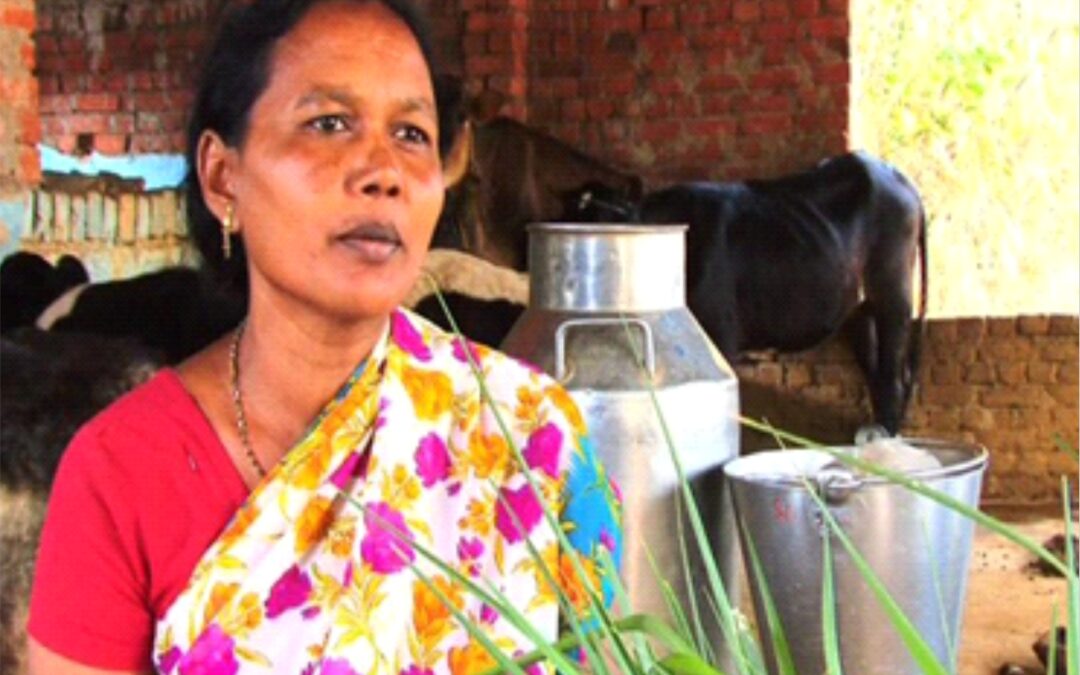
Sushma Lakda, a woman dairy farmer from Kudu Navatoli, Lohardaga, Jharkhand, narrated her experience in maintaining a herd of 20 cows who yield 80-100 litres of milk every day enabling her to pursue the engineering studies of two of her sons and daughter in the capital city of Ranch and Steel city of Jamshedpur, also proudly stated that her children are proud of their mother’s achievements. Till 2003, Sushma used to sell Hadu (liquor made from rice) on the roadside. Her net income is in the range of Rs. 28000 – 30000 per month. Sushma has received several awards and is considered a role model in the state.

Blazing a New Trail

Blazing a New Trail

Vijaya Rani, an AI technician, operating a franchised cattle development centre in Chanamuthyreddy Gudern village in Atmakur Mandal, Nalgonda district of Andhra Pradesh since 2003, was conferred the “Women Achievers’ Award” by the Times Foundation, Delhi, in collaboration with FICCI – Young FICCI Ladies Organisation (YFLO) for her contribution to community development. She has been providing breed improvement and health care services to farmers of 15 villages. So far, she has performed 5321 AI, of which, 3913 pregnancies have been confirmed and 2552 crossbred calves have been born at the doorsteps of the farmers. She performs 900-1000 AI annually and earns approximately Rs. 6000 per month. She has conducted awareness programmes for dairy farmers 8-10 times in a year and 2 health camps in all the villages. Vijaya Rani has planted subabu on 16 ha o wastelands to ensure regular supply of fodder for cattle. She also functions as a resource person to train youth from Karnataka and Andhra Pradesh in operating franchise centres. This bold woman who is mother of three, moves from village to village on her motor cycle providing extension services at the doorsteps of farmers.