Knowledge Sharing Workshop

Knowledge Sharing Workshop

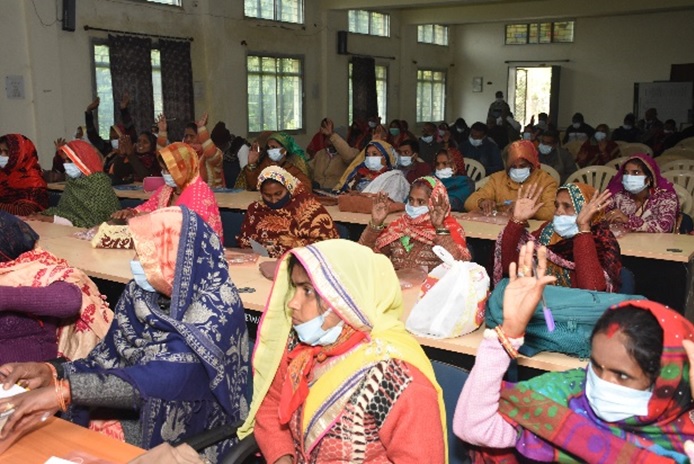
To disseminate knowledge, experience and information among participants about schemes of various Government departments and process for registration through the representatives of the Lines Department, Scientists of Krishi Vigyan Kendra and Corporates, a Knowledge Sharing Workshop was organized on December 31, 2021 at the Krishi Vigyan Kendra (KVK) at Rewa in Madhya Pradesh under the Climate Smart Village Programme supported by Mahindra & Mahindra and Implemented by BISLD Madhya Pradesh.

The Chief Guest, Dr. S.K. Pyasi, Dean, Government Agriculture College, Rewa, highlighted Climate Resilient Crops and emphasised on suitable seed selection for climate change adaptation. The Special Guest, Shri. Sunil Dhikle, District Development Manager, NABARD, Rewa, focussed on the need to accept climate change and to change farm practices for better production and for minimising farming cost. Dr. A.K. Pandey, Head Krishi Vigyan Kendra, Rewa, provided inputs to farmers on Package of Practices for Black Gram. The proceedings were chaired by the Principal Scientist & Head of KVK. Shri. Yogesh Pathak, Deputy Director, Horticulture, Rewa. Shri. Lalji Singh, Assistant Director, Fisheries, also provided valuable information.

The technical sessions focussed on scientific methods and process and farming and how farmers can promote climate resilient crops in their farms and were conducted by Dr. A.K. Pandey, Dr. R.K. Joshi, Principal Scientist from Agriculture College, Dr. C.G. Singh, Dr. A.K. Patel, Dr. A.K. Tiwari, Dr. Sanjay Singh, Dr. K.S. Bhaghel and Shri. Sandeep Sharma. The workshop was attended by more than 100 farmers of which 57 were women farmers, from Khaira, Magurihai, Padiya, Belaha, Khokham, Deora, Mahidal, Agdal, Umri and Naroura blocks of Rewa district.

Kisan Diwas celebrated at BAIF

Kisan Diwas celebrated at BAIF

Kisan Diwas – National Farmers’ Day is observed every year on December 23 – the birth anniversary of Chaudhary Charan Singh – former Prime Minister of India and hailed as a champion of farmers. This day which is a day of celebration of the farming community, is also observed by BAIF and its Associate Organisations across 12 states to recognise the valuable contribution of small and marginal farmers in the sustainable development programme.

On December 23, 2021, 30 champion women farmers of the Prerna Project from 6 villages of Hunsur, Mysuru, Karnataka, were taken on an exposure visit to the Agriculture Extension Education unit of the Organic Farming Research Station at Naganahalli in Mysuru district to create awareness on sustainable agricultural practices for improved crop productivity. The women were oriented on climatic uncertainties, water management for better productivity, Systematic Rice Intensification and Integrated farming system for doubling their farm income and also learnt of the successful experience of a progressive farmer in adoption of improved farming practices.

With this field visit and enhanced knowledge, these champion women farmers can surely become custodians of sustainable agricultural practices and sensitise a large number of women farmers on efficient farming practices.

The Prerna Project is being jointly implemented by Mahindra & Mahindra (M&M) and BAIF in Mysuru and Tumkur, Karnataka, Nashik and Aurangabad, Maharashtra, Vidisha and Sehore, Madhya Pradesh, Jamnagar and Tapi, Gujarat and Amethi in Uttar Pradesh to empower women farmers as change makers in agriculture.

Holistic Programme Launched in Hingoli, Maharashtra with support of HDFC

Holistic Programme Launched in Hingoli, Maharashtra with support of HDFC

BAIF Institute for Sustainable Livelihoods and Development, Maharashtra, launched the Holistic Rural Development Programme supported by HDFC Bank Ltd., at Taktoda village, Sengaon in Hingoli district of Maharashtra on December 21, 2021.

The programme covering 11 villages of Hingoli district, included inauguration of a utensil store and a flour mill to ensure additional income generation for women-headed families under the project. Mr. Jitendra Papalkar, District Collector, Mr. Sanjay Daine, CEO, Zilla Parishad, Mr. Shivaraj Ghorpade District Superintendent Agriculture Officer, Hingoli, Dr. P.P. Shelke, Head and Senior Scientist, Prof. Rajesh Bhalerao Subject Specialist, KVK Tondapur, Mr. Anil Olambe, Mr. Ajaykumar Sugave, Dr. Kailas Gite, Mrs. Sridevi Patil, Asst. Police Inspector, Goregaon, Mr. S.R. Bele, Block Development Officer, Sengaon, Mr. Pramod Sawke, Sarpanch and VDC members from the villages graced the occasion.

The village community took an oath to keep their villages and surrounding environment clean in line with Swachh Bharat Mission of the Government of India. The event was facilitated by the BISLD Maharashtra Project team headed by Mr. Shailesh Bhagat, Additional Chief Programme Executive, Nagpur, who shared an overview of the Holistic Programme and the plan to establish a farmer producer organisation in future.  Mr. Shelke highlighted the joint effort of BAIF and KVK in promoting short duration turmeric and BSMR 736 pigeon pea varieties in the project area. Others who spoke on the occasion included the CEO, Zilla Parishad and the District Collector, Hingoli who also highlighted various schemes being implemented by the State Government through the Gram Panchayats. The vote of thanks was proposed by Mr. Dalit Manwar, BISLD. The programme was enriched with good wishes conveyed by Mr. Retish Sinha, Head CSR, HDFC Bank Ltd., Mr. Pavan Dongre CSR Manager, HDFC Bank Ltd., Mr. V.B. Dyasa, Regional Director – Western Region, BAIF and Mr. S.M. Wagle, Chief Programme Executive, BISLD, Maharashtra.

Habitats and Ecosystems Restoration in Uttarakhand

Habitats and Ecosystems Restoration in Uttarakhand

BAIF has taken up various initiatives across India to ensure participatory management and eco restoration of commons / community pasture lands. These efforts have also resulted in rejuvenation of habitats and setting in important ecological processes in these identified landscapes. Development of pastures on village common land with improved varieties of forage species, has demonstrated conservation of pastures and sustainable development of the community.

Van Panchayat lands in the North Western Himalayan region of Uttarakhand, have been developed into community silvipastures through a participatory approach. A nursery of 50,000 fodder plants has also been established by two silvipasture groups of women in Champawat.

A short film titled “Van Panchayat – The Forest Commons of Himalayas” developed by Seema Ravandale and Kuldeep Saratkar, is among the list of finalists in the World Commons Week 2021 video contest. The film highlights forest management measures adopted by the local communities of this hilly region through the traditional system of Van Panchayats with special focus on the restoration efforts of a group of women at Mannar, Champawat, under the climate change adaptation project implemented by BAIF and BISLD Uttarakhand, with the support of NABARD and Adaptation Fund Board (AFB).

The 4th Annual Worlds Common Week organized by The International Association for the Study of the Commons, Ostrom Workshop, School of Public Policy, School of Earth and Sustainability and University of Massachusetts Amherst, aims at creating a greater understanding of the commons-related knowledge across the globe, foster mutual exchange of ideas and celebrate and expand the research and practice of commons.

The video can be watched here: https://lnkd.in/eqkAA7iX

The video film which was shortlisted among the list of five finalists, was awarded the First Prize

Custodians of Development Honoured by BAIF

Custodians of Development Honoured by BAIF

Padma Shri Rahibai Popere and National Genome Saviour Farmer Award recipient Mamta Bhangare from Ahmednagar district of Maharashtra, were felicitated by BAIF Development Research Foundation on December 7, 2021 at its Head Office in Pune. It was the BAIF Agrobiodiversity team, who had discovered and nurtured their passion for conservation of indigenous seeds and wild vegetables.

Rahibai from Kombhalne tribal village, popularly known as “Seed Mother”, is a Godmother to more than 3500 women farmers. Featuring among BBC’s 100 influential women trailblazers from more than 60 countries and in an award winning documentary at the Cannes Film Festival, recipient of Nari Shakti Puraskar, National Social Innovation Award and Vasantrao Naik Puraskar, this familiar face on national and regional television networks, has pioneered a movement to preserve traditional seeds while giving a boost to agriculture within the tribal community. This seed and plant conservationist is also an active member of the 2021 National Plant Genome Savior Community Award recipient Kalsubai Parisar Biyane Sanvardhan Samajik Sanstha, a community seed bank and seed saver group.

Mamta Bhangare from Devgaon village, who considers herself as a woman farmer, is modesty personified. This unassuming kitchen garden guide, has conserved 69 landraces of paddy, beans and local vegetables and has won acclaim for her conservation and cultivation techniques of wild vegetables while relying on organic farming and innovative vermi briquettes.

Bharat Kakade, President and Managing Trustee, Girish Sohani, Principal Adviser and Trustee, Rajashree Joshi, Programme Director and Sanjay Patil, Senior Thematic Programme Executive, BAIF, lauded Rahibai and Mamta’s knowledge awakening efforts and for linking science and technology to achieve the leap from Grassroot to Global and Research for Use.

Sustainable Development of Tribal Families

Sustainable Development of Tribal Families

BAIF’s Unique Approach to Migration free Rehabilitation with Ecological Restoration
Tribal communities in India are characterized by chronic poverty, alienation, lack of choice and absence of hope. Understanding the need to rehabilitate the families in their own environs and acknowledging their affinity towards trees, an innovative ‘Wadi’ programme was evolved by BAIF in 1982, by enabling tribal families to establish fruit orchards on their denuded lands, which generated cash income and food crops for home consumption. This system of agri-horti-forestry, ensured climate resilient food production, enabling over two lakh Scheduled Tribe families from 6483 villages in 11 states, to come out of poverty. This pioneering programme of Tribal Rehabilitation with an innovative approach to rehabilitate these forest loving families, has ensured food security, safe drinking water, improved health, education of children, empowerment of women and active participation in village governance. The programme has sequestered 2 million tons of carbon dioxide during the last 10 years.

The Tribal Development Centre established by BAIF in South Gujarat, has been recognised as a Centre of Excellence for developing rural technologies for improvement in livelihood and quality of life by the Ministry of Tribal Affairs, Government of India.

On the occasion of the first Tribal Pride Day (Janjatiya Gaurav Diwas) observed on November 15, BAIF pledges to continue its efforts to restore the dignity of the true custodians of our green cover and groom them as the frontline development team of the country.

The Gandhian Legacy: Manibhai Desai and BAIF

The Gandhian Legacy: Manibhai Desai and BAIF

Dr. Manibhai Desai – the Founder of BAIF, was a close associate of Mahatma Gandhi. Understanding the challenges of a majority of the rural families who were living in poverty with denuded natural resources, he focussed on promotion of appropriate technologies as a tool for conservation and making optimum use of them to generate sustainable livelihood. He gave priority to improving the progeny of non-descript cows owned by most of these families as a liability. The families were able to produce high yielding cows and buffaloes at their door steps without any investment, enjoy food security and come out of poverty.

This success motivated him to transform other challenges into new opportunities. As feeding of nutritious fodder could increase the profitability of dairy husbandry, he promoted cultivation of hardy, perennial fodder crops on degraded wastelands which were lying idle. Establishment of drought resistant fruit trees on denuded hilly terrains, was another initiative to rehabilitate the Scheduled Tribe families living in chronic poverty. To improve crop productivity, soil conservation and innovative water resources development programmes were introduced. Rural women were encouraged to participate in all the development programmes and to educate their children. These programmes conceived by him 5-6 decades ago, have addressed many of the UN Sustainable Development Goals and are serving as the foundation for evolving climate-smart agricultural initiatives to counter the current challenges of global warming.

He was a rare Gandhian who made rural development and agriculture his mission and who worked for the welfare of the weaker sections of the communities until his last breath. On his death anniversary (November 14, 2021), we pay our homage to him and pledge our continued mission of rural prosperity.

4 per 1000 initiative:  Mandate of BAIF

4 per 1000 initiative: Mandate of BAIF

BAIF is one of the signatories of the ‘4 per 1,000’ multi-country initiative which was launched by the Government of France at the COP21 Paris Climate Summit held in 2015, with direct participation in four Tasks to increase carbon storage in agricultural soils by 0.4% every year to mitigate climate change, increase food security and reduce greenhouse gas emissions to ensure highly resilient agriculture through appropriate management of lands and soils to ensure carbon storage. BAIF is now formally a part of the Thematic Task Forces set up under the 4 per 1000 initiative to fulfil its mandate namely Reference Framework, Soil Regeneration, Good Agricultural Forestry and Other Land Use Practices (GAFOLUP) Helpdesk and Capacity Development. BAIF has developed suitable thematic proposals on restoration of soil fertility by adopting sustainable agriculture practices for food security and climate change adaptation and SDG Good Practices, adhering to the mandate of 4 per 1000 initiative.

On the occasion of “4 per 1000 Day” 2021 High-Level Segment held at Glassgow, Scotland on November 10, 2021, the President and Managing Trustee of BAIF, Mr. Bharat Kakade delivered a special talk.

The Gandhian Legacy

The Gandhian Legacy

BAIF is fortunate that its Founder, Late Dr. Manibhai Desai, a staunch follower of Mahatma Gandhi, had adopted the basic principles of Gandhian values for rural development and put them into practice through various field programmes. He used to ensure that the programmes benefitted the vulnerable sections of the society through inclusive development. While planning any activity, the first and foremost thought always in his mind was how this activity would be able to benefit the weaker sections of the society and hence, he used to modify the programme to address their problems. Keeping in mind the need for effective involvement of the community, BAIF has developed community-based organisations to take care of sustainable development. The programmes have been modified with time and new programmes have been introduced over the last five decades, but what has not changed till today, is our firm belief in the Gandhian Values for Rural Development.

The principles and perspectives articulated by Gandhiji have been applied by BAIF in all its programmes for rural livelihood to transform the Gandhian vision into reality. While Sarvodaya has been adopted by BAIF as the key to sustainable development, his dream of Gram Swarajya, continues to be the goal. On the occasion of the 152nd birth anniversary of Mahatma Gandhi, BAIF pays homage to the Father of the Nation.

Agro-Biodiversity Conservation and Climate-resilient Agriculture

Agro-Biodiversity Conservation and Climate-resilient Agriculture

BAIF Development Research Foundation (BAIF), Pune, organised a webinar on “Native Biodiversity Conservation and Seed Savers” on September 30, 2021. The forum included an in-depth discussion between BAIF’s Agro-Biodiversity Specialist and Senior Thematic Programme Executive, Mr. Sanjay Patil based at Jawhar in Palghar district, who is also a Member of the Management Committee of the National Bureau of Plant Genetic Resources (NBPGR), Indian Council of Agricultural Research, Padmashree recipient, Smt. Rahibai Popare from Akole, Ahmednagar district, popularly known as “Seed Mother” and 300 rural farmers, researchers, scientists and educationists working in the field of rural development and biodiversity conservation across the country including Pratham, People’s Archive of Rural India (PARI), Sukh Bhoomi India Trust and Sahyadri School.

This thematic webinar focussed on native varieties of diverse food crops such as maize, rice and millets, their characteristics, nutritive value and the significant role of thousands of committed community seed farmers and seed savers located in remote areas of Maharashtra and other parts of the country in transforming Indian agriculture from a traditional system to a climate-based agriculture system and who have been recognised and awarded various national awards under various Government schemes. Smt. Rahibai also shared her vast experience in community development through conservation and popularisation of indigenous seeds and their landraces. The forum included a question and answer session at the end of the discussions.

This webinar marks the beginning of various webinars being planned by BAIF on similar topics. For more information, you may visit www.elearning.baif.org.in

55th Foundation Day of BAIF Celebrated

55th Foundation Day of BAIF Celebrated

Addressing adverse impact of climate change on vulnerable communities, innovative technologies for human and environmental well-being, creating leadership among women, focus on non-farming communities and carbon positive development, are the strategic directions, stated Mr. Bharat Kakade, President and Managing Trustee at the 55th Foundation Day of BAIF which is serving 40 lakh families from one lakh villages in 12 states of India. The target is to reach 1.0 crore families in the next five years. The inherent capacity is the 6000 plus employees and dedicated field team. “Anna, Akshar, Arogya and Aacharan”- practiced by Shri. Arvindbhai Mafatlal, former Chairman, have been adopted with Gandhian engineering. Integration of human nutrition with conventional programmes, enriching the core programme with new age science and technology, agro-biodiversity and farm mechanisations are some of the immediate goals and Gandhian values, sustainability, institution building, being rooted to the ground and support from participant families, Central and State Governments, scientific institutions and corporate partners, are the guiding forces, he concluded.

The BAIF Annual Report, Research Highlights, Agroecology Approach to Sustainable Farming, Kaleidoscope – Resource Guide, Indigenous Crop Diversity – A Catalogue of Landraces, Establishment and Management of Community Seed Banks, Madhuca indica (Mahua): A Candidate Tree Catalogue and Approaches and Guidelines for Agro-biodiversity Conservation and Revival were released.

Best Cattle Development Centre In-charge – Mr. Rajkumar Maurya, UP, Best Multi-Activity Centre In-charge – Mr. Thippani Suresh, Telangana, Differently-abled AI technician – Mr. Sakhigopal Sahu, Odisha, Best Agricultural Farmer – Ms. Yashoda Yadav, MP, Best Dairy Farmer – Ms. Prema G.S., Karnataka and Best Wadi Farmer -Mr. Shamlal Vaishnav, Rajasthan. Dr. Manibhai Desai Gaurav Puraskar – Jamuna SHG, Betul, Second Best SHG – Urja Group, Urulikanchan and the Best SHG in Maharashtra – Mahalaxmi Matoshree Group.

The Guests of Honour were Mr. Vinod Kulkarni, CSR Head, The Tata Motors Ltd. and Mr. Santanu Ghoshal, Vice President, HR, Schaeffler India. Mr. Kulkarni appreciated the partnership with BAIF and the innovative hub programme for sustainable livelihood. Mr. Ghoshal expressed his appreciation of the work of BAIF and the impact of social investment.

Mr. Kishor Chaukar, Trustee, BAIF acknowledged the contribution of the messengers of BAIF in the growth of BAIF. Mr. Sunil Lalbhai, Chairperson, Finance Committee and HR Committee of BAIF Trustees appealed to BAIF to work on Five Minds of the Future for excellence.

Dr. Ashok Pande, Mr. Shrinivas Kulkarni, Mr. Sujit Gijare and Mr. Vijay Deshpande spoke on the occasion. The virtual event was attended by Mr. Girish Sohani, Principal Adviser and Trustee, BAIF and the BAIF staff.

BAIF completes 54 years of service in Rural Development

BAIF completes 54 years of service in Rural Development

​On August 24, 1967, the Foundation Stone of BAIF was laid at Urulikanchan, near Pune, by the-then President of India, Dr. Zakir Hussain. It took 20 years for Dr. Manibhai Desai, who came to Urulikanchan in 1946 with Mahatma Gandhi, to develop a suitable income generation programme to address rural poverty. With the support of farmer leaders of Maharashtra, Manibhai established a Charitable Trust – “Bharatiya Agro Industries Foundation” (BAIF) to ensure remunerative employment for rural households at par with Industries and which was later renamed as “BAIF Development Research Foundation” to reiterate its focus on research and development for transferring modern, appropriate technologies to small farmers. The Founder Trustees included Shri. Yashwantrao Chavan, the-then Defence Minister of India as the Chairman, Shri. Vasantrao Naik, Chief Minister of Maharashtra as the Vice Chairman and Shri. Annasaheb Shinde, Union Minister of State for Agriculture, as Trustee. Later, Shri. Arvind Mafatlal joined the Trust as Chairman.

BAIF has contributed innovative and replicable models of development across the country. The climate-resilient multidisciplinary development programmes, professionally managed by more than 6000 employees, are benefitting 40 lakh families from 80,000 villages of 328 districts in 12 states. Over the years, various dignitaries have visited Urulikanchan including Prime Minister of India, Shri. Morarji Desai in 1977 and President of India, Dr. A.P.J. Abdul Kalam in 2002. Prime Minister of India. Shri. Narendra Modi addressed BAIF through video conference on the occasion of its Golden Jubilee in 2017.

On the occasion of its 55th Foundation Day on August 24, 2021, BAIF acknowledges the valuable guidance of its Trustees and support of its donors, well-wishers and participant families.