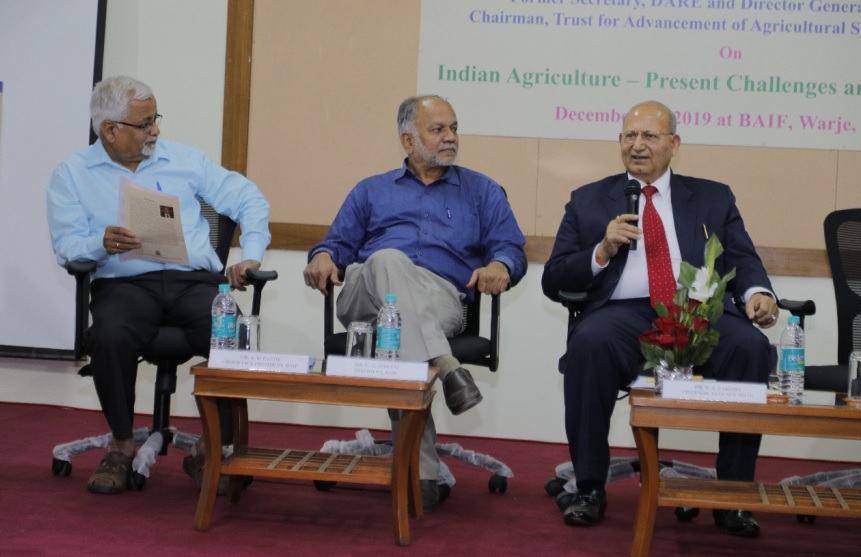
The 52nd Foundation Day and Annual Award ceremony of BAIF was celebrated on August 24, 2019 at BAIF’s Central Research Station, Urulikanchan. “Neer, Nari and Nadi”, are the basic components of a balanced eco system. Only when science i s used with sense, will community wisdom be recognised”, stated Dr. Rajendra Singh, Chairman, Tarun Bharat Sangh, Alwar, Rajasthan. Solar energy needs to be used effectively for water conservation and Mother Earth nurtured through sustainable watershed management, climate change adaptation and mitigation methodologies and by guiding the community towards a river- based approach.
“Hydraulic drought, a serious effect of climate change, is changing the production pattern of food and fruit crops with apple orchards being the worst a f f e c t e d w i t h s e v e r e destruction of apple crops, while frequent droughts with atleast 2-3 in quick successions have direct impact on the lives of vulnerable families”, stated Mr. Bharat Kakade, Executive Vice President of BAIF. While BAIF has shifted to climate proofing measures such as desert development in Rajasthan and water conservation measures in drought prone Karnataka and Andhra Pradesh and climate resilient tree-based farming on dryland, it is necessary to assess which model is suitable for the community. Chemical- free farming has also been initiated on a pilot scale with the introduction of Integrated Renewable Energy and Sustainable Agriculture (IRESA) and Phosphate Rich Organic Manure.
Suman Self Help Group, a tribal group from Baretha village of Betul district, Madhya Pradesh, was awarded “Dr. Manibhai Desai Gaurav Puraskar 2019 and Smt. Vijayatai Deshmukh Gaurav Puraskar” for Best Self Help Group in BAIF Programme for its efforts to enhance village hygiene and sanitation through construction of 45 toilets under Water, Sanitation and Hygiene ( WA S H) Programme and Swachh Bharat Programme, use of waste water to establish kitchen gardens for intake of nutritious vegetables, p r a c t i c i n g o r g a n i c farming to reduce risk of chemical hazards and adoption of smokeless chulhas to reduce health and environmental hazards.
Bajrang Women’s Group from Dixal village, Kaprada, South Gujarat won the “Dr. Manibhai Desai Gaurav Puraskar 2019” for Second Best Self Help Group in BAIF Programme. The group launched a campaign for prohibition of alcohol in the village while establishing a grievance platform for marital disputes.
Sidheshwar Women’s Group from Shirapur village, Parner, Ahmednagar district of Maharashtra, was the recipient of “Dr. Manibhai Desai Gaurav Puraskar 2019” for Best Self Help Group in Maharashtra Programme. The group initiated Custom Hiring Centre through BAIF from 2017 and so far, they have earned more than Rs. 85,000 with 149 farmers from different villages availing hiring service of various farm implements. They have also p r o v i d e d a g r i c u l t u r a l i m p l e m e n t s t o n e e d y farmers free of charge.
Smt . Kempamani , Guddenahalli village , Holenarasipura, District Hassan, Karnataka was Best Dairy Farmer; Smt. Lalita Baraskar, Banspur village, Ghodadongri, District Betul, Madhya Pradesh was Best Agriculture Farmer; Smt. Nilu Devi, Sarobag, Dharhara, Munger, Bihar was the Best Farmer from Non-Potential Area; Shyam Sunder, Cattle Development Centre at Atai, Gautam Buddha Nagar, Uttar Pradesh, was the Best Cattle Development Centre In-charge; Manoj Wakode, Cattle Development Centre at Wari , Kopargaon , Ahmednagar, Maharashtra was Best AI Technician from Multi-Activity Centre; Anil Kumar Mishra, Cattle Deve lopment Centre at Chandanbhati, Bolangir district of Odisha for Best AI Technician from Non-Potential Area. Prizes were a l so g i ven to meritorious students and for the best scientific paper and case study. The BAIF Annual Report, Research Report and a book on Mahua Recipes were also released on this occasion.
The BAIF Shri. Uday Shirsalkar, C G M , NABARD, Maharashtra Regional Office, Pune, complimented the women fraternity who were felicitated for their work and for their confidence to share their experience. Ms. Ritu Nathani, Director, Cybage Software Pvt. Ltd. and Head – Cybage CSR, Pune, appreciated the women for establishing their identity through their empowerment. Others who spoke on the occasion were Dr. Anand Sardeshmukh, former Director General, MCCI and Shri. Sunil Lalbhai, Trustee, BAIF. Earlier, Dr. Ashok B. Pande, Group Vice President, BAIF, welcomed the women groups. Dr. Jayant R. Khadse, Research Director, BAIF, proposed the vote of thanks.