World Food Day

World Food Day

Oct. 16, 2022: World Food Day is observed by BAIF through the implementation of its innovative agri-horti-forestry and climate-resilient programmes in diverse agro-climate conditions which have ensured food and nutritional security to distressed families including women and children, thereby combating malnutrition and safeguarding them from other health hazards.

Mahila Kisan Diwas and International Day of Rural Women

Mahila Kisan Diwas and International Day of Rural Women

Oct. 15, 2022: Women play important role in nurturing the family and contributing for family income in agrarian rural Indian communities by participating in labour-intensive agricultural processes and conservation of indigenous crops, dairy and livestock management and fodder cultivation especially in Andhra Pradesh. BAIF Development Research Foundation celebrated their contribution in developing rural livelihoods on the occasion of Mahila Kisan Diwas and international day of Rural Women.

In Andhra Pradesh, Mahila Kisan Diwas and international day of Rural Women was celebrated at Chimalivarigudem village, Buttayigudem Mandal, Eluru District under ITC MSK ABC-80 project and Vemulapadu village, Owk Mandal, Nandyal District under Tata power project. Women self-help groups were invited in programmes. The SHGs have developed an internal credits and savings system to strengthen the financial freedom of participants. Sustainable Agricultural Practices in paddy crop especially green manuring, vermicompost usage in paddy and follow Direct Seeded Rice were successfully demonstrated during the events. These techniques help to reduce water usage and cost of cultivation. The SHG groups were also given training in vermicompost production and Ram lamb rearing to generate income in short duration.

In Lakheri, Rajasthan, the celebrations took place in the presence of ACC Ahead President, Mrs. Shobha Dubey. Padmashri Mrs. Rahibai Popere was also present as chief guest. Guests spoke about organic farming, its benefits and elaborated on the role women play in developing rural economy. 125 women were present for the event. Other CSR officials from ACC Cement were also present for the function.

At BISLD Prayagraj, under WLP project, interaction with women took place. Similar programmes were organised at many literacy centres in Bundelkhand. A dialogue with women encouraged them to discuss their experiences with peer groups.

Green Fodder to the Rescue

Green Fodder to the Rescue

Rasilaben Bheraji from Khedasan village in Sabarkantha district, enrolled for the Utthan project supported by McCain Foods India Pvt. Ltd. With technical information on genetically improved variety of fodder BNH 10 and supported with 500 stem cuttings she initiated farming with BNH 10 on her own land. By the end of the year, she ensured abundant green fodder for her beloved animals year-round, resulting in improved milk yield and additional income of INR 30,000 through sale of surplus green fodder in the market.

She purchased another cow which resulted in additional income. Inspired by her, many farmers from the region have also started cultivating BNH 10 on their farm land with hope of changing their prospects.

Today, she is instrumental in making Khedasan village self-sufficient in perennial green fodder and increased milk production.

Wadi provides Hope

Wadi provides Hope

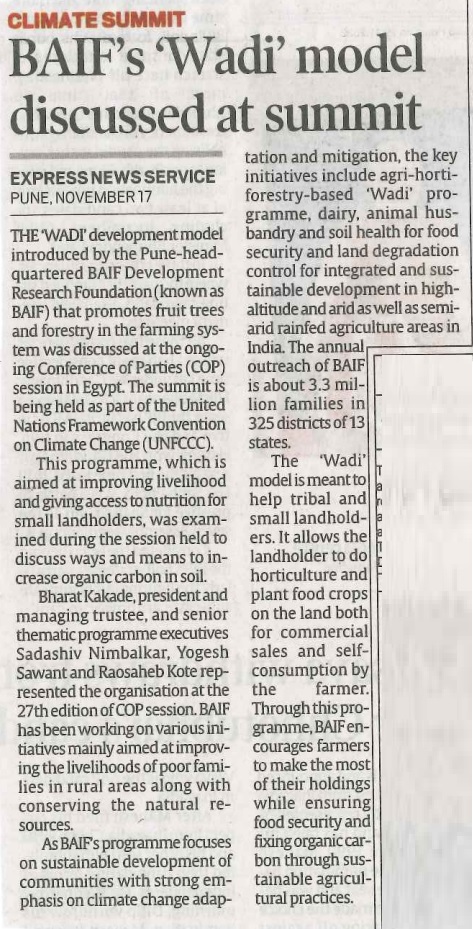
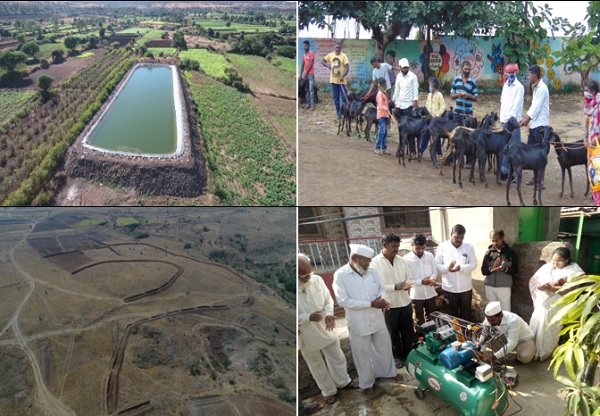
Yashwant, a resident of Shiroshi village in Jawhar, Palghar district and a father of two, inspite of owning 2 ha was forced to migrate to nearby cities of Palghar, Nashik and Mumbai. Realising that he could not continue this way, this fourth standard pass, enrolled for a training programme on wadi and decided to cultivate horticulture crops and floriculture on 0.8 ha land. Tata Motors supported him with saplings and for water storage in a farm pond under the Integrated Village Development Programme. His chilli crop fetched him INR 67,500 in the first season itself with marketing support from BAIF Livelihoods. He also had a successful experience with jasmine cultivation within 10 months of plantation. Yashwant was supported with various interventions such as fish farming, installation of solar pump, groundnut cultivation, establishment of nursery and biogas unit. Presently, he is earning INR 6000 to 8000 from fish farming and vegetable cultivation and an additional INR 5000 after deducting all the input costs.

He is confident of being able to provide good education to his children. He is also relieved that he does not have to migrate and be separated from his family.

Best Wadi Participant

Best Wadi Participant

Vinod Bhengra, a resident of Raidung village and a participant of the Wadi Programme funded under the NABARD – Tribal Development Fund implemented at Torpa, Khunti district, was felicitated by the Chief Minister of Jharkhand, Shri. Hemant Soren on February 23, 2022 in Ranchi.

He planted guava and mango along with brinjal, green chilli, tomato and okra as intercrops. Training in agricultural development at Birsa Agricultural University, Ranchi and ICAR Research Complex for Eastern Region at Palandu enabled him to gain technical know-how. He sold vegetables after a year of plantation. In 2018, he received a good produce which fetched him an attractive price in the market. He planted wild grass intermeshed with bamboo on the periphery of his wadi which with subsequent rains after plantation, resulted in natural protection. Vinod also planted French beans which further enhanced his income. Adjudged the “Best Farmer” by Birsa Agricultural University, Ranchi, he markets his produce through OMON Producer Company Ltd., promoted by BISLD Jharkhand. He obtained INR 50,000 from watermelon and jackfruit crop while his annual income from wadi increased to Rs. 6 lakhs (0.6 million).

Trellis farming catches the attention of traditional farmers

Trellis farming catches the attention of traditional farmers

Parameshwar Gadua lives with his family in Dahimal village in Balangir district. Due to recurrent drought, he was not able to support his family. Learning about the benefit of trellis farming system, he decided to take up cultivation of Bitter gourd adopting trellis farming. He was amazed when he obtained an astonishing yield of 10 kg in the first harvest and thereafter every week and which increased to 50 – 60 kg yield per week subsequently. While he is keeping aside a small quantity for the household, he is selling the rest in the local market. So far, he has earned INR 24,000/- from sale of 800 kg of Bitter gourd. Parameshwar is today a satisfied farmer.

Wadi inspires Others

Wadi inspires Others

Philips Hembrom from Barmanni village, Munger, struggled to support his large family comprising of his wife and five children from mining activity.

He joined the wadi programme. His wadi comprises of mango, jackfruit, guava and papaya and vegetable crops such as Bottle gourd, Ladies finger, Bitter gourd, Ridge gourd, pulses and mustard. With the income from wadi, Philips purchased two cows.

 His wife is a member of the SHG formed by BAIF and she makes 300 leaf plates per day which fetch her INR 64,800 in six months. The total annual income of the family from wadi, sale of milk and leaf plate making is INR 1.34 lakhs (0.134 million).

His stable income has enabled him to fund his son’s higher education at a private college in the nearby city of Bhagalpur. He has also been able to ensure the marriage of his 4 daughters. However, Philips feels that his singular achievement has been the addition of another 44 community members in wadi cultivation.

Organic farming for a better Future

Organic farming for a better Future

Yennaram Prameela is a sprightly 50-year old woman farmer from Machireddypally village of Sangareddy district who has been engaged in farming along with her husband since the age of 25. A keen believer in modern agricultural production technologies, this bold woman approached the field team of the Microsoft-supported Jaivik Mitra Project in 2019 and adopted advancedorganic vegetable cultivation practices such as Jeevamruta unit, vermicompost units, crop rotation and automated micro sprinkler irrigation system. Today, with advanced agricultural technologies, she is able to cultivate multiple varieties of vegetables in her 1.2 ha of land.

Her income increased by 35% by adopting improved sustainable farming technologies. With project support, she was able to supply her farm fresh vegetables to organic stores in Hyderabad with 10% extra premium price compared to the normal market price. Prameela foresees a bright future in organic farming.

Adoption of Natural Farming

Adoption of Natural Farming

Farmers of Purimetlu village in Mundalamuru Mandal in Prakasam district including Umareddy Venkateswara Reddy, had never grown any crop other than tobacco and chilli due to low groundwater table.

The Agri Business Centre established in the village enabled them to hire water pipes for critical irrigation which also improved their crop yield. Umareddy adopted zero budget natural farming. He dug a pond and adopted drips and sprinklers, while adding cow dung and urine to improve soil fertility.

In convergence with the Agriculture Department, he made use of crop protection measures. He was also advised to plant trap crops such as castor, marigold and establish border plantations of millets such as jowar and bajra. With these plant protection measures, his yield from cash crops, millets, vegetables, trap crops and fruit crops improved along with enhanced income.

The bio-diversity on his farm is evident. His daily earning is on an average INR 1500 a day and is a source of inspiration for enthusiastic farmers eager to change their fortunes.

From Vulnerability to Sustainability

From Vulnerability to Sustainability

Six years ago, Lata Devi from Manar village in Lohaghat, Champawat, was clueless about climate-smart interventions. With the entry of BAIF into her village, she shifted to protective cultivation in low-cost bamboo polyhouse. She was trained in nursery raising and spacing of crops inside the polyhouse which enabled her to take up production thrice a year. She adopted roof top rainwater harvesting and gravity drip irrigation. The shift from local cultivars to high value vegetables such as capsicum, tomato, cabbage and cucumber fetched an attractive price at the local market in July-August when similar produce from plain areas were still not available in the markets. A certain quantity of the produce is kept aside for consumption by the family. The average Income/year/family owning one animal and one poly house of 60 m2 has been INR 30,000 from protective cultivation and INR 50,000 from milk production. Additional Income is also generated through nursery raising activity. Sustainable livelihood is now a reality.

The Winners

The Winners

Rajabai and Sonabai from Majhgawan block of Satna district received the First and Second Best Farmer prizes for establishment of wadi on 0.4 ha land under the Tribal Development Fund of NABARD.

Life for Rajabai Gond of Chithara village, was a struggle after the death of her husband. Sonabai from Devlaha village was forced to migrate with her husband to support the family. To transform their lives, both of them joined the wadi programme whereby they planted 10 plants of mango, 20 plants of papaya, 30 plants of anola and 200 karonda saplings on 0.4 ha. Seeds of seasonal vegetables crops such as pea, tomato, brinjal, gourd, bitter gourd, onion and moong were distributed to them as intercrops. Deepening of well by a group of neighborhood farmers led to protective irrigation of their orchards and year-round vegetable production. To protect their orchard from wild animals, they erected a barbed wire fence. From an earlier annual income of INR 20,000, they started earning INR 250 to INR 300 every day by selling vegetables. They are now able to access information on various Government schemes and their benefits for improvement of their wadi. Rajabai and Sonabai have inspired many other women farmers who now consider wadi as their hope for the future.

Desert-based Livelihood

Desert-based Livelihood

Earlier, women in Lunkaransar block in the desert region of Bikaner had to travel 4-6 km every day in search of drinking water. To address this critical issue, two Tankas of 30,000  litres capacity each , were constructed under the ITC Mission Sunehra Kal Project. With this benefit, the families are consuming the water which to them tastes like nectar as well as for theirbanimals . This water conservation structure while reducing the hardships of women is also ensuring protective irrigation to their wadi plantations and enabling them to devote some time to wadi development. Desert development has shown the families the road to development.